87
This review article examines The Compendium of the Histories of the
Arabian Peninsula and Persia, 1622–1810 CE, a massive 33-volume
historical undertaking by His Highness Sheikh Dr Sultan bin Muhammad Al
Qasimi, Ruler of Sharjah. Published in 2025 by Al Qasimi Publications, it is
an exceptional collection of 1,473 historical documents from English, Dutch,
French, Ottoman and Portuguese archives in parallel Arabic and English
editions. The Compendium is the culmination of more than forty years of
archival research and is probably the most comprehensive documentary
history of the Arabian Gulf ever assembled. The review looks at the scope of
the work, its methodological approach, its contribution to scholarship, and its
potential to transform historical research on the Gulf and the wider Indian
Ocean world. It argues that the Compendium not only fills an important gap
in the historical record but also sets a new paradigm for documentary
historiography in the Arab world by combining rigorous archival scholarship
with unprecedented accessibility for researchers across the globe.
Keywords
Arabian Peninsula;
Persian Gulf;
Historiography;
Archival Documents;
Sheikh Sultan Al Qasimi;
Gulf History;
Documentary History;
Early Modern History
QALAMOS
Heritage Studies
Vol. 2, Issue 1, pp. 87-97
Published: Jan. 2026
ID : QALAMOS.2.1.1.2026.006 DOI: 10.5281/zenodo.21247890
The Compendium of the Histories
of the Arabian Peninsula and
Persia, 1622–1810 CE:
A Landmark in Gulf
Historiography
Ahmed Ameen1,2
ahmed.ameen@sharjah.ac.ae
ORCID 0000-0002-1898-2781
1 University of Sharjah, Sharjah, United Arab Emirates
2 Faculty of Archaeology, Fayoum University, Egypt
Abstract
Received: Sep. 25, 2025
Accepted: Nov. 17, 2025
Published: Jan 1, 2026
Conflict of Interest: None declared
Funding: Not applicable
Author(s) Contributions:
Author 1. Ahmed Ameen

The Compendium of the Histories of the Arabian Peninsula and Persia, 1622–1810 CE: A Landmark in Gulf Historiography
88
1. Introduction
The historiography of the Arabian Peninsula and Persian Gulf has long been troubled by what
might be called a documentary asymmetry. The region’s strategic significance as a nexus of
maritime commerce, imperial aspirations, and cultural interaction has never been in question;
however, the historical narrative has been disproportionately shaped by the viewpoints of
European colonial powers, Ottoman administrators, and Persian dynasties, frequently
sidelining the voices and stories of the local populace (Sharjah Ruler's Official Website, 2025a;
UrduPoint, 2025). Into this historiographical lacuna steps The Compendium of the Histories of
the Arabian Peninsula and Persia, 1622–1810 CE, a work of such scope and intent that it
requires a reconsideration not only of the period it covers but of the very ways in which Gulf
history has been written (Sharjah Ruler's Official Website, 2025b).
A scholar-ruler whose historical publications have won international recognition, His Highness
Sheikh Dr Sultan bin Muhammad Al Qasimi, is the author of the Compendium, comprising 33
volumes in Arabic and 33 in English, containing 1,473 historical documents, and also available
in a digital format (Sharjah Ruler's Official Website, 2025c). The time span it covers, from the
fall of Hormuz in 1622 to the dawn of the nineteenth century in 1810, includes nearly two
centuries of profound transformation, during which European maritime powers (Portuguese,
Dutch, British, and French) vied with Persian, Ottoman, and local Arabian polities for control
over the Gulf's trade routes and strategic chokepoints (Sharjah Ruler's Official Website, 2025a;
Al Fajr, 2025; Rashed & AbdulKarim, 2025).
This review article places the Compendium in the wider field of the historiography of the Gulf,
elaborates on its methodological basis and documentary architecture, evaluates its academic
importance, and considers its implications for future research. In doing so, it contends that the
Compendium is in effect not just an anthology of documents, but a founding act of historical
recovery, one that reclaims a trove of primary sources from the archives of Europe, Turkey,
and elsewhere and puts them into a systematic, scholarly form (Sharjah Ruler's Official
Website, 2025a).
A
B
The Compendium of the Histories of the Arabian Peninsula and Persia 1622 CE - 1810 CE,
(A) QR to the 33-volumes Compendium; (B) the cover of Volume Fifteen,
Sharjah Ruler's Official Website (2025c). The compendium of the histories of the Arabian
Peninsula and Persia

Ahmed Ameen
pg. 89
2. The Author and His Scholarly Context
Any serious engagement with the Compendium must begin with an appreciation of the author’s
unique position at the intersection of political leadership and historical scholarship (Al-Qāsimī
1999). Sheikh Dr Sultan bin Muhammad Al Qasimi has over the past few decades become one
of the most prolific and respected historians of the Gulf region. His previous publications
include the five-volume History of Al Qawasim (Al-Qāsimī 2025a), which traces thirteen
centuries of Al Qasimi family history from the first year of the Hijra (622 CE) to 1240 AH
(1825 CE), and The Portuguese in the Sea of Oman: Annals of History 1497–1757, a 21-
volume publication on which the Compendium is based (Al-Qāsimī 2025b).
The Compendium is explicitly presented as a continuation of this earlier Portuguese study.
Sheikh Sultan’s introductions to volumes 1-12 point readers looking for information about
events between 1622 and 1645 to The Portuguese in the Sea of Oman, volumes 17-20. This
painstaking intertextual architecture shows a scholar thinking in terms of a comprehensive
historical corpus rather than isolated publications, a vision that has now culminated in what he
himself has called his "greatest work" (Al-Qāsimī 2025c).
The author’s method has been analysed in scientific works where researchers have pointed out
accuracy, objectivity and scientific documentation as features of his method. One study
concludes that "Sheikh Al Qasimi's methodology is a distinguished model for the accuracy of
historical research" and recommends its adoption in developing curricula for historical studies.
This methodological rigour is evident throughout the Compendium, eschewing interpretive
gloss in favour of presenting documents in their original form, arranged chronologically, and
with careful scholarly apparatus (Rashed & AbdulKarim, 2025).
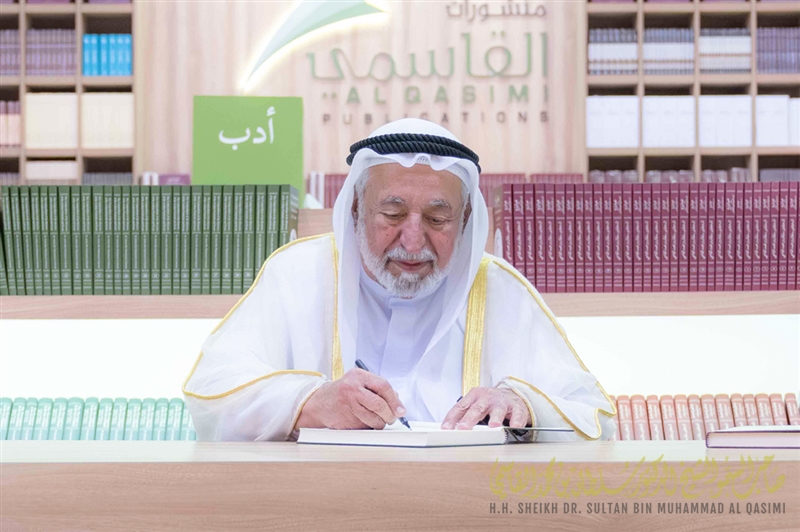
H.H. Ruler of Sharjah signs his latest publication, "The Compendium of the Histories" at the
inauguration of 44th Sharjah International Book Fair - 5 November 2025,
Source: Sharjah Ruler's Official Website. (2025e).

The Compendium of the Histories of the Arabian Peninsula and Persia, 1622–1810 CE: A Landmark in Gulf Historiography
90
3. Documentary Architecture and Scope
3.1. Scale and Structure
The Compendium is enormous. It comprises 33 volumes in each of two languages, making a
total of 66 physical volumes and 1,473 individual documents, representing possibly the largest
single documentary publication in the history of Gulf studies. The work gives “the whole
history of the region in chronological annals”, sorting the documents by year, and within each
year by episode (Sharjah Ruler's Official Website, 2025a; UrduPoint, 2025).
Volume Seven, which is treated here as a representative example, covers six years, 1728 to
1733. The contents are indicative of the richness of the documentary basis of the Compendium:
they record the conflicts between Sheikh Rashid and the Afghans, the continued Portuguese
presence on the Island of Qeshm, the Dutch occupation of Hormuz, the ambush by which the
Afghan forces captured the Dutch administration in Gombron and the attempt by Sheikh
Rahmah bin Matar Al-Qasimi of Julfar to gain control of Hormuz. It includes a number of
letters about the appointment of Abdullah Khan as governor-general, including requests for
permission to use sea routes for commercial vessels. It depicts the Dutch attempt to rescue their
captured officials, which claimed the lives or life-threatening injuries of most of them, and the
subsequent siege of the Dutch trading station. It notes commercial treaties, instances of plunder,
the Dutch capture of Bandar Abbas and the destruction of the old Portuguese fort there. Here
in one volume is the complex, many-layered dynamic of Gulf politics in the early eighteenth
century, when European trading companies, Persian governors, Afghan invaders and local
Arab sheikhs operated within a constantly shifting landscape of alliance and conflict (Al-
Qāsimī 2025c, Vol. 7).
Volume Fifteen, examined here as a second characteristic instance, encompasses the events of
six critical years, from 1783 to 1788. Its contents illustrate the remarkable diversity of the
Compendium's documentary base, capturing a transitional epoch defined by the precipitous
decline of Dutch commercial authority and the strategic ascendancy of British naval
intervention. This volume documents the fracturing of Persian sovereignty in the wake of
Karim Khan Zand’s demise, the defiant consolidation of the Qawasim maritime federation
along the lower Arabian coast, and the escalating Omani naval ambitions under the nascent Al
Bu Sa‘id dynasty. It reveals a collection of letters concerning the volatile administration of
Bandar Abbas, including urgent missives regarding the appointment of unstable Persian
governors-general, detailed customs ledgers from the Dutch factory, and repeated petitions
from British factors demanding the restitution of seized cargoes and the enforcement of safe-
passage protocols along the Strait of Hormuz. It recounts the beleaguered Dutch East India
Company’s final, desperate attempts to salvage their imperilled interests at their Kharg Island
outpost—an effort severely hampered by the internment of their chief factors and the
subsequent, protracted siege of their commercial station by combined Persian provincial forces
and allied local tribesmen (Al-Qāsimī 2025c, Vol. 15).
Furthermore, the volume records the gritty negotiation of interim maritime truces, the
systematic plundering of vulnerable trading dhows by rival tribal confederations, the strategic
dispatch of British naval squadrons from Bombay to curb escalating maritime depredations,
and the methodical demolition of obsolete Portuguese and Dutch fortifications that had long
dominated the Gulf’s littoral. This single volume thus encapsulates the complex, multi-layered
dynamics of Gulf politics in the late eighteenth century, where the decaying Persian Zand court,
the ambitious Omani fleet, the vigilant British East India Company, and the fiercely
independent Arab sheikhs of the Trucial Coast interacted in a constantly shifting landscape of
economic survival, tribal alliance, and armed confrontation (Al-Qāsimī 2025c, Vol. 15).

Ahmed Ameen
pg. 91
3.2. Documentary Sources
The really different thing about the Compendium is its documentary basis. Sheikh Sultan has
searched through English, Dutch, French and Ottoman sources as well as references to
Portuguese documents formerly incorporated into The Portuguese in the Sea of Oman. The
author has observed that “It contains Dutch, British, French and rare Ottoman documents. We
were able to access Istanbul’s archival centres and collect a lot of material. Of particular
importance is the use of “extensive French archival documents from the French Foreign
Ministry,” a source that has been “previously unexplored” in this context (Al Fajr, 2025).
The linguistic range of the source material is remarkable: documents in English, Dutch, French,
Portuguese and Ottoman Turkish have been collected, transcribed, translated (where necessary)
and presented in a consistent format. This multilingual approach reflects the cosmopolitan
nature of Gulf history itself, where European trading companies, Ottoman administrators,
Persian governors and local Arabian rulers carried out their affairs in a polyglot environment
of diplomacy, commerce and conflict (Sharjah Ruler's Official Website, 2025d).
3.3. Chronological and Geographical Coverage
The Compendium is temporally bounded between 1622 and 1810, the choice of the years was
deliberate. The starting point 1622 is the fall of Hormuz, a landmark event in which Portuguese
control over the entrance to the Gulf was broken and new powers began to make their mark
(first the English then the Dutch). The endpoint, 1810, is before the final consolidation of
British hegemony in the Gulf and is the moment of greatest multipolarity in the early modern
history of the region (UrduPoint, 2025).
Equally ambitious in scope as well as in geography. Sheikh Sultan has asked researchers to
study a work that “deals with the Arabian Peninsula and Persia, including Oman, the UAE,
Qatar, Bahrain, Kuwait, Basra, Dir’iyah, the Hijaz, Persia and the Ottomans in Baghdad”. This
covers the Gulf littoral, but also the interior of the Arabian Peninsula, the Persian heartland,
and the Ottoman provinces of Iraq, a geographical scope that reflects the interconnected nature
of the region’s political and commercial systems (Sharjah Ruler's Official Website, 2025a).
4. Methodological Innovations and Scholarly Apparatus
4.1. The Annalistic Method
The Compendium is written in an annalistic form, giving "the whole history of the region in
chronological annals". This choice is important methodologically. Rather than imposing a
thematic or narrative framework that might betray the author’s interpretative concerns, the
annalistic approach allows the documents to speak for themselves, preserving the contingency
and complexity of the historical events in the order in which they occurred. Readers experience
the historical record in something akin to its original temporal texture, a sequence of events,
decisions, conflicts, and negotiations that together make up the region’s history (Sharjah
Ruler's Official Website, 2025a).
The method is rooted in the Islamic historiographical tradition, from the early ta'rikh works to
the great universal chronicles of the mediaeval period. The Compendium is thus a deliberate
engagement with this tradition, adapting it to the particular requirements of documentary
history. As Sheikh Sultan himself has put it, the work “presents the complete history of the
region in the form of events in annals”, a formulation which explicitly evokes this classical
mode of historical writing (Sharjah Ruler's Official Website, 2025a).
The Compendium of the Histories of the Arabian Peninsula and Persia, 1622–1810 CE: A Landmark in Gulf Historiography
92
4.2. The Researcher's Guide and Scholarly Apparatus
Sheikh Sultan, recognising the challenges researchers encounter when dealing with such a large
collection, has supplied a Researcher's Guide with the volumes. The guide includes document
numbers, subjects and locations within the collection. Researchers can easily find materials
relevant to their studies, for example, by searching “the fall of Hormuz” and locating all
references and page numbers of the documents. This apparatus turns the Compendium from a
collection into a usable tool for research. It lowers the bar for entry for scholars who may be
daunted by the magnitude of the task (Sharjah Ruler's Official Website, 2025a).
The scholarly apparatus also extends to the presentation of the documents themselves. Sheikh
Sultan “used symbols to refer to explanations in the margins and used Arabic transliteration for
foreign words only the first time they appear, then consistently used the Arabic term throughout
the remainder of the text.” This concern for the reader’s experience, striking a balance between
scholarly rigour and readability, speaks to a profound understanding of the needs of the
academic audience (UrduPoint, 2025).
4.3. Citation and Academic Integrity
One of the most important methodological decisions, with far-reaching implications for
academic practice, is that of citation. Sheikh Sultan has stressed that 'researchers should refer
to the original source of the document in their research and not The Compendium of the
Histories itself'. The publication of the Compendium has given scholars access to the original
documents, as a first point of reference. Researchers can also mention in the introduction of the
studies that most of the documents were from Sheikh Sultan and not repeat the reference after
each citation for academic integrity (Sharjah Ruler's Official Website, 2025a; 2025d).
The decision is notable for its scholarly generosity. Sheikh Sultan has consciously subordinated
his own work to the primary sources it contains, a perfectly understandable position given the
scope of the endeavour, rather than positioning the Compendium as a definitive interpretation
of the documents it comprises. The Compendium will not have the final word on Gulf history.
It is a gateway to the documents that will allow future scholars to write that history themselves.
This is historiography at its most self-effacing, and paradoxically, its most potent.
5. Scholarly Significance and Contribution
5.1. Filling a Documentary Lacuna
The Compendium addresses the perennial problem in Gulf historiography: the scattering of
primary sources in archives in a number of countries and languages. As Sheikh Sultan has
mentioned, researchers face serious problems in travelling to faraway countries and in
translating large amounts of archival material, which might lead to fruitless endeavours if
relevant sources are not found. The Compendium is an effective answer to this difficulty,
collecting in one place documents formerly scattered through archives in the Netherlands,
Britain, France, Turkey, Portugal and elsewhere (Sharjah Ruler's Official Website, 2025a).
Such a consolidation of sources can revolutionise the field. Whereas a researcher interested in,
say, Dutch-Qasimi relations in the 1730s would have had to track down archives in The Hague,
London, Paris, and Istanbul, a logistical challenge that could take years and require multiple
research grants, that researcher can now find the relevant documents in one collection, with
translations and scholarly apparatus already provided. Few previous publications have
democratised access to Gulf history in quite the same way as the Compendium (UrduPoint,
2025).
Ahmed Ameen
pg. 93
5.2. The Multilingual Dimension
The multilingual character of the Compendium is not merely a practical convenience, but a
methodological intervention. The work provides documents in the original languages with
translations, allowing scholars to face the full complexity of the historical record. The original
documents preserve the subtleties of diplomatic language, the precision of commercial
terminology, and the sometimes-revealing infelicities of translation that marked intercultural
communication in the early modern Gulf (Al Fajr, 2025).
Furthermore, the combination of Ottoman Turkish documents and European sources creates
new opportunities for comparative analysis. The Ottoman archives, however, contain a wealth
of material on the Gulf, which has not been sufficiently explored by scholars working mainly
in European languages. The Compendium, by making these documents available, opens the
way to a more integrated historiography, one that does not privilege European perspectives,
but considers all sources as equally valuable windows on the region’s past (Sharjah Ruler's
Official Website, 2025d).
5.3. Local and Regional Perspectives
A particularly important contribution of the Compendium is its focus on local Arabian actors
and their agency. The documents show a lively political scene where local leaders, Sheikh
Rashid, Sheikh Rahmah bin Matar Al-Qasimi, Sheikh Sha’ban, Sheikh Ahmad Madani,
followed their own interests, forged alliances and competed for power, rather than a quiet land
swept along by European imperial efforts. The Compendium mentions "the attempt of Sheikh
Rahmah bin Matar Al-Qasimi of Julfar to take Hormuz", "the struggle between Sheikh Rashid
and the Afghans", and "correspondence between Sheikh Ahmad Madani and the Dutch" (Al-
Qāsimī 2025c, Vol. 7).
Our understanding of Gulf history has far-reaching consequences from the emphasis on local
agency. In these documents the Gulf emerges not as a mere backdrop to European imperial
rivalries, but as a region with its own political dynamics, its own conflicts and alliances, and
its own historical trajectory, in which European powers were significant actors but by no means
the only or even dominant ones (Al-Qāsimī 2025c, Vol. 7).
5.4. Contribution to Indian Ocean Studies
The Compendium is also a welcome contribution to the broader field of Indian Ocean studies.
The Gulf was no closed region, but an important node of a network of maritime links from East
Africa to Southeast Asia. The documents collected in the Compendium illuminate the ties that
bound Gulf politics to the wider Indian Ocean world, the movement of ships, goods and people,
the flow of information and intelligence, and the shared commercial and diplomatic practices
that linked the Gulf to India, Southeast Asia, and beyond (Sharjah Ruler's Official Website,
2025a).
The emphasis on the period 1622-1810 is particularly useful for Indian Ocean historians. This
was the age of the ascendancy of the Dutch and English East India Companies, the decline of
Portuguese power, the rise of new regional polities, and the transformation of maritime trade
networks. The Compendium provides the documentary basis for a more integrated
understanding of these developments that does not see the Gulf as a periphery of European
imperialism, but as a key arena of Indian Ocean history.
The Compendium of the Histories of the Arabian Peninsula and Persia, 1622–1810 CE: A Landmark in Gulf Historiography
94
6. Accessibility and Digital Innovation
6.1. Bilingual Publication
The publication of the Compendium in Arabic and English is in itself a major scholarly
achievement. Students of Arabic now have a wide range of documents which were previously
available only in European languages. Students of English can consult the whole range of
sources without having to master a variety of European languages and Ottoman Turkish. The
bilingual format also facilitates comparative reading, enabling scholars to observe how the
same events were documented across different traditions (Sharjah Ruler's Official Website,
2025a).
6.2. Digital Availability
The digital format of the Compendium is also a significant innovation in scholarly publishing.
Digital access revolutionises the research process by allowing keyword searching, cross-
referencing and the kind of large-scale textual analysis that is becoming ever more central to
historical research. The digital format also means that the Compendium can be made available
to a global audience, including scholars at institutions that may not have the resources to
purchase the full 66-volume print edition (Sharjah Ruler's Official Website, 2025c).
This commitment to digital accessibility symbolises a broader recognition that scholarships in
the twenty-first century must embrace new technologies. As Sheikh Sultan has noted, the
Compendium is 'a unique resource for postgraduate studies and research, providing clear,
organised and precise information'. This digital format makes this resource available to a new
generation of scholars who are increasingly conducting their research online.
7. Implications for Future Research
7.1. New Research Agendas
The publication of the Compendium creates a lot of new research agenda. Now, scholars can
undertake systematic research on topics that were difficult to study when sources were
dispersed: the political history of individual Gulf ports; the economic history of trade networks;
the diplomatic history of the relationships between European companies and local rulers; the
social history of the Gulf’s diverse populations; the environmental history of a region shaped
by its maritime environment (Sharjah Ruler's Official Website, 2025d).
The Compendium also opens up new possibilities for comparative research. Scholars can
compare the versions of the same event presented in English, Dutch, French and Ottoman
sources to see the different perspectives and interests that shaped how they were recorded. They
can map the flow of information across the Gulf and beyond, tracing the circulation of news,
intelligence and rumours that constituted the region’s information ecology.
7.2. Methodological Implications
The methodological choices of the Compendium, its annalistic form, its emphasis on primary
sources, its self-effacing authorial stance, have consequences beyond the specific content of
the work. The Compendium models a particular approach to documentary history that other
scholars working on other regions might emulously emulate. It shows that large-scale
documentary publishing is possible, that it can be done to the highest scholarly standards, and
that it can make a transformative contribution to historical knowledge.
The Compendium also brings up questions about the relationship between primary sources and
historical interpretation. Sheikh Sultan has thus made the documents available in their original
form, and invited future scholars to develop their own interpretations, to write the history of
Ahmed Ameen
pg. 95
the Gulf from the sources he has compiled. It is a generous and intellectually honest approach
to historical scholarship that recognises that history is an ongoing conversation, not a settled
narrative.
7.3. Educational Applications
The Compendium has a lot of potential to serve as an educational resource. It is “a unique
resource for post-graduate studies and research”, Sheikh Sultan has noted. The collection can
be used in graduate seminars to train students in the reading and analysis of primary sources;
in undergraduate courses to provide students with direct access to the documentary record; and
in the training of future historians of the Gulf region (Sharjah Ruler's Official Website, 2025d).
The bilingual format makes the Compendium particularly useful for educational purposes.
Students working in Arabic have the option of the original versions or documents in their own
language; students working in English can do the reverse. This bilingual accessibility means a
wider cross-section of students can study Gulf history than would otherwise be the case
(Sharjah Ruler's Official Website, 2025c).
8. Critical Assessment
8.1. Strengths
There are many strengths in the Compendium. It is unique in its scale and comprehensiveness
in the historiography of the Gulf. Its documentary basis, drawn from archives in many countries
and languages, is extraordinarily rich. Its scholarly apparatus, including the Researcher’s Guide
and a careful eye to citation practices, makes the collection usable for serious research. The
bilingual format and online availability make it very accessible. Its methodological choices,
the annalistic format, the emphasis on primary sources, the self-effacing authorial stance reveal
a deep and sophisticated understanding of historical scholarship (Sharjah Ruler's Official
Website, 2025a).
Most important of all, the Compendium is an act of genuine scholarly generosity. Sheikh Sultan
has spent decades assembling this collection, has provided it in a form accessible to researchers,
and has explicitly invited scholars to cite the original sources, not his own work. This is
scholarship in the service of knowledge, not of private fame.
8.2. Limitations and Considerations
No project of this size is without its limitations. The nature of the Compendium is to be a
corpus-platform of documents, rather than interpretive history. If the reader is looking for a
historical interpretation about the time, they will have to revise more references or more likely
make up their own stories based on the material presented. The work also reflects the
limitations of its sources. These are mainly the documents of the European trading companies
and Ottoman administrators, with local Arabian voices mostly being heard through their
interactions with these external actors. Although the Compendium does much to recover local
agency, the documentary record remains, ineluctably, one constructed from the vantage point
of the power structures of the early modern Gulf.
There may also be questions about how complete the collection is. Sheikh Sultan has said that
this work is a sequel to his earlier study of the Portuguese and that for information on certain
periods, readers should consult that earlier study. The Compendium is therefore part of a larger
scholarly enterprise, and the importance of the work can only be understood in the context of
this larger corpus (Sharjah Ruler's Official Website, 2025a).
The Compendium of the Histories of the Arabian Peninsula and Persia, 1622–1810 CE: A Landmark in Gulf Historiography
96
8.3. Place in the Historiographical Tradition
The Compendium holds a special place in the historiographical tradition of the Gulf. It draws
on the classical Islamic tradition of annalistic history and engages with the documentary
practices of European archival scholarship. Written by a ruling sheikh, it continues a tradition
of princely patronage of history with deep roots in the Islamic world and provides an object
lesson in the highest standards of modern academic scholarship (Sharjah Ruler's Official
Website, 2025c).
In this sense, the Compendium is a synthesis of different historiographical traditions, a work
that is simultaneously Arab and international, traditional and modern, local and global. Perhaps
the most distinctive contribution of the work is the synthesis it offers. It demonstrates that
rigorous historical scholarship can be conducted in an Arab intellectual frame of reference, that
the documentary methods of European archival research can be applied to the history of the
Gulf, and that a work of this scale and ambition can originate in the Arab world.
9. Conclusion
The Compendium of the Histories of the Arabian Peninsula and Persia, 1622–1810 CE is a
landmark publication in Gulf historiography. Its 33 volumes, 1,473 documents, and
multilingual source base are an extraordinary scholarly achievement, the culmination of more
than four decades of archival research and a testament to the vision and commitment of its
author.
The Compendium fills an important gap in the historical record by bringing together a wealth
of primary sources previously scattered in archives in several countries and languages. Its
methodological choices, the annalistic format, the emphasis on primary sources, the careful
scholarly apparatus, set a new standard for documentary history in the region. The bilingual
format and the availability in digital form allow us to reach the widest possible audience of
scholars, students and interested readers.
Perhaps most importantly, the Compendium opens new avenues for historical research on the
Gulf. Sheikh Sultan has opened the door for future scholars to write the history of the region
themselves, to make new interpretations, to ask new questions, to create new narratives, by
making the sources available. It is not the last word on the history of the Gulf but a foundation
on which a new generation of scholarship can be built.
In a region where history has often been written by outsiders and by competing national
narratives, the Compendium provides a rare resource: a documentary record that can be
common ground for scholars of different traditions and perspectives. It is a work of historical
preservation in the truest sense, one that ensures that the rich and complex history of the
Arabian Peninsula and Persia in the early modern period will not be lost, but will be available
to generations of scholars to come.

Ahmed Ameen
pg. 97
10. References
1. Al Fajr, Sharjah Ruler: "The Compendium of the Histories" brings together English, Dutch,
French, Ottoman, and Portuguese documents documenting the history of the region
between 1622 and 1810. (2025, November 5). https://www.alfajr-news.net/details/
(Accessed 5 Dec. 2025)
2. Al-Qāsimī, Sultan bin Muhammad (1999), Power struggles and trade in the Gulf 1620-
1820, Al Qasimi Publications, Sharjah, United Arab Emirates.
3. Al-Qāsimī, Sultan bin Muhammad (2025a), History of Alqawasim, 5 Vols., Al Qasimi
Publications, Sharjah, United Arab Emirates.
4. Al-Qāsimī, Sultan bin Muhammad (2025b), The Portuquese in the Sea of Oman Annals of
History 1497 CE – 1757 CE, 21 Vols., Al Qasimi Publications, Sharjah, United Arab
Emirates.
5. Al-Qāsimī, Sultan bin Muhammad (2025c) The Compendium of the Histories of the
Arabian Peninsula and Persia 1622 CE – 1810 CE. 33 Vols., Al Qasimi Publications,
Sharjah, United Arab Emirates.
6. Rashed, F., & AbdulKarim, M. (2025), “Characteristics of the historical methodology of
Sheikh Dr. Sultan bin Muhammad Al Qasimi,” Al-Adab Journal, 152, 249–276.
https://doi.org/10.31973/xdwgc037
7. Sharjah Ruler's Official Website (2025a), Sultan: "The Compendium of the Histories" was
given this name because it brings together all the English, Dutch, French, Ottoman, and
Portuguese documents documenting the history of the region between 1622 and
1810Sharjah Ruler's Official Website. (2025, November 5)
https://sheikhdrsultan.ae/Portal/en/media-center/news/5/11/2025/ (Accessed 11 Dec.
2025)
8. Sharjah Ruler's Official Website (2025b), Sultan: "The Compendium of the Histories" is a
gift to researchers in the Gulf and the Arabian Peninsula Sharjah Ruler's Official Website.
(2025, July 29). https://sheikhdrsultan.ae/Portal/en/media-center/news/29/7/2025/.aspx
(Accessed 20 Nov. 2025)
9. Sharjah Ruler's Official Website (2025c): The compendium of the histories of the Arabian
Peninsula and Persia 1622 CE–1810 CE. https://sheikhdrsultan.ae/Portal/en/official-
positions/historical-works/compendium.aspx#page=1 (Accessed 1 Oct. 2025)
10. Sharjah Ruler's Official Website (2025d), Sultan announces "The Compendium of the
Histories" to debut at SIBF 2025 (2025, September 15)
https://sheikhdrsultan.ae/Portal/en/media-center/news/15/9/2025/.aspx
11. Sharjah Ruler's Official Website (2025e). The compendium of the histories of the Arabian
Peninsula and Persia [Image].
https://sheikhdrsultan.ae/Portal/Content/Generated/Thumbnails/a5c6a8d3_3201x2bc1WT
ransparent.jpg
12. UrduPoint (2025), Sharjah Ruler: "Compendium of the Histories" supports researcher.
(2025, November 5). https://www.urdupoint.com/en/middle-east/sharjah-
rulercompendium-of-the-histories-s-2078230.html (Accessed 2 Dec. 2025)