Coptic Textile Epigraphy in Fayoum
الكلمات المفتاحية:
Coptic Epigraphy; Inscription; Textile; Tiraz Style Naqlun; Tutun.الملخص
https://doi.org/10.5281/zenodo.18436367
Abstract
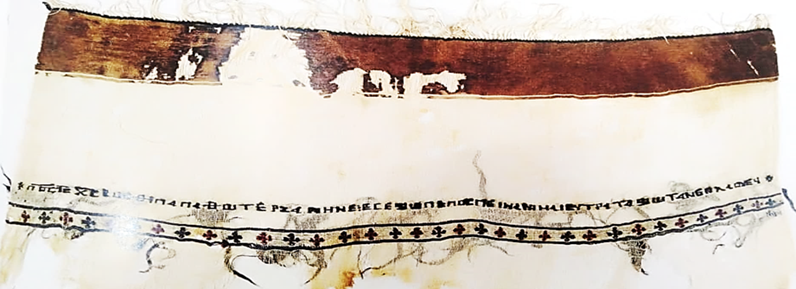
Fayoum is one of the most prominent centers of Coptic textile production, distinguished by its artistic skill and precision in design, in addition to the fact that it contains written inscriptions that were not just written decoration, but rather a means of expressing faith and protecting the person or place in which the textile was used, as well as identifying its identity, sometimes identifying the Coptic workshops in fayoum and it also reflects the language used and some linguistic and cultural influences through some of the religious supplications and texts used. Therefore, this research sheds light on the nature of these inscriptions, knowing their content and significance through a group of models, the most important of which is known as Tiraz style, which features Arabic inscriptions, along with a Christian Tiraz style, which features Christian-themed inscriptions, including crosses and Christian letters.
التنزيلات
المراجع
1- Boud'hors, A., & Calament, F. (2004). Un ensemble de stèles fayoumiques inédites: À propos de la stèle funéraire de Pantoleos de Toutôn. In M. Immerzeel & J. van der Vliet (Eds.), Coptic studies on the threshold of a new millennium: Proceedings of the Seventh International Congress of Coptic Studies, Leiden, August 27-September 2, 2000, Peeters Publishers. (pp. 447-476).
2. Bosson, N. & Sydney H. A. (1999). [= Cat. Lattes, 1999], Egyptes… L’Égyptien et le copte. Exposition Lattes, musée archéologique, Henri Prades.
3. Czaja-Szewczak, B. (1999). Textiles from Naqlun. Polish Archaeology in the Mediterranean, 10, (pp. 135-142).
4. Czaja-Szewczak, B. (2005a). Textiles from Naqlun 2004. Polish Archaeology in the Mediterranean, 16, (pp. 203-210).
5. Czaja-Szewczak, B. (2005b). Tunics from Naqlun. In G. Gabra (Ed.), Christianity and monasticism in the Fayoum Oasis, American University in Cairo Press. pp.133-142
6. De Moor, A., Verhecken-Lammens, C., & Van Strydonck, M. (2006). Relevance and irrelevance of radiocarbon dating of inscribed textiles. In C. Fluck & G. Helmecke (Eds.), Textile messages, Brill. (pp. 223-231).
7. Durand, M. (2002). Usage des textiles Coptes. In M. Durand & F. Saragoza (Eds.), Égypte, la trame de l'histoire: Textiles pharaoniques, coptes et islamiques, Somogy. (pp. 77-81).
8. Durand, M. (2009). Inscribed fabrics from Egypt: A study in Greek and Coptic textile epigraphy. Journal of Coptic Studies 11, (157-180.)
9. Durand, M., & Rettig, S. (2002). Un atelier sous controle califal identifié dans le Fayoum: Le ṭirāz privé de Ṭuṭūn. dans cat. exp. Egypte, la trame de l'Histoire. textiles pharaoniques, coptes et islamiques, Rouen, Musée départemental des Antiquités. (pp. 167-170).
10. Edwards, E., & Farag, N. (2019). Fayoum textiles features during Tulunid period 868-905. Minia Journal of Tourism and Hospitality Research Vol. (7), No. (1/2), (pp. 75-91).
11. Fluck, C. (1996). Koptische Textilien mit Inschriften in Berlin (I). Bulletin de la Société d'Archéologie Copte, 35, (pp. 161-172).
12. Fluck, C. (1997). Koptische Textilien mit Inschriften in Berlin (II). Bulletin de la Société d'Archéologie Copte. (pp. 59-70).
13. Fluck, C. (2005). A textile puzzle from Arsinoe. In G. Gabra (Ed.), Christianity and monasticism in the Fayoum Oasis: Essays from the 2004 International Symposium of the Saint Mark Foundation and the Saint Shenouda the Archimandrite Coptic Society in honor of Martin Krause American University in Cairo Press. (pp. 144-153).
14. Fluck, C. & Helmecke, G. (2006). Textile messages, inscribed fabrics from Roman to Abbasid Egypt. Brill.
15. Fluck, C., Linscheid, P., & Merz, S. (2000). Textilien aus Ägypten: Teil 1: Textilien aus dem Vorbesitz von Theodor Graf, Carl Schmidt und dem Ägyptischen Museum Berlin. Reichert Verlag.
16. Godlewski, W. (2002). Les textiles issus des fouilles recentes de Naqlun. In M. Durand & F. Saragoza (Eds.), Égypte, la trame de l'histoire: Textiles pharaoniques, coptes et islamiques, Somogy. (pp. 100-104).
17. Godlewski, W., Herbich, T., & Wipszycka, E. (1990). Deir El Naqlun (Nekloni). 1986-1987: First preliminary report. Nubica, 1(2), (pp. 171-207).
18. McWilliams, M., & Sokoly, J. (2021). Social fabrics: Inscribed textiles from medieval Egyptian tombs. Harvard Art Museums.
19. Morgan, F. P. (2018). “Dress and personal appearance in late antiquity: The Clothing of the Middle and Lower Classes. Leiden–Boston: Brill.
20. Rutschowscaya, M.H, Wipszycka,E.,& Du Bourguet,P. (1991). Textiles, Coptic. The Coptic Encyclopedia 7, Macmillan. (pp. 2210b-2230b).
21. Rouen, 2002-2003: Égypte, la trame de l’Histoire. Textiles pharaoniques, coptes et islamiques. Musée départemental des Antiquités.
22. Soldati, A. G. F. (2017). A new piece in the prosopography mosaic of the Coptic scriptorium of Toutōn: Pantouleos, son of Houmise. Comparative Oriental Manuscript Studies Bulletin, 3. (pp. 23-32).
23. Stauffer, A. (1995). Textiles of late antiquity. Metropolitan Museum of Art.
24. Timm, S. (1991). Das christlich-koptische Ägypten in arabischer Zeit: eine Sammlung christlicher Stätten in Ägypten in arabischer Zeit, unter Ausschluß von Alexandria, Kairo, des Apa-Mena-Klosters (Dēr Abū Mina), der Skētis (Wādi n-Naṭrūn) und der Sinai-Region/Teil 5 (Q-S).
25. Van der Vliet, J. (2000). A Naqlûn monk brought home: On the provenance of Louvre inv. E 26798-26799. Bulletin de la Société d'Archéologie Copte, 39. (pp. 239-244).
26. Van der Vliet, J. (2006). "In a robe of gold": Status, magic and politics on inscribed Christian textiles from Egypt. In C. Fluck & G. Helmecke (Eds.), Textiles messages: Inscribed fabrics from Roman to Abbasid Egypt, Brill. (pp. 23-67).
27. Van der Vliet, J. (2018). Reconstructing the landscape: Epigraphic sources for the Christian Fayoum. In The Christian epigraphy of Egypt and Nubia, Routledge. (pp.99-109).
28. Winnik, A. (2025). Inscribing the Christian body in life and death. In The medieval Mediterranean between Islam and Christianity: Crosspollinations in art, architecture, and material culture, The American University in Cairo Press. (pp. 199-220).