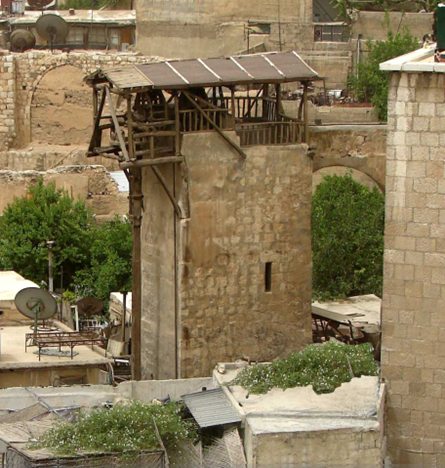
One of the Most Prominent Landmarks of Our Scientific Heritage: Sheikh Muhyiddin’s Sāqiyah in Damascus
الكلمات المفتاحية:
Sāqiyah; Damascus; Sheikh Muhyiddin; Mamluk period; Islamic architectureالملخص
https://doi.org/10.5281/zenodo.18435815
Abstract
Sheikh Muhyiddin's Sāqiyah in Damascus exemplifies Islamic scientific heritage, showcasing the advanced engineering and innovation achieved during the Islamic Golden Age. The Sāqiyah, a mechanical water-lifting device, demonstrates the importance of water in Islamic culture and its association with purity and spiritual practices. Designed by the notable engineer Taqi al-Din al-Shami in the 16th century, the structure combines art, science, and spirituality, demonstrating the Islamic world's commitment to public welfare through technology. The Sāqiyah served various community needs, providing water for mosques, hospitals, and irrigation.
التنزيلات
المراجع
1. Akkach, S. (2015, August 27). The eye of reflection: Al-Nabulusi’s spatial interpretation of Ibn ʿArabi’s tomb. Muqarnas Online. Koninklijke Brill B.V. https://brill.com/view/journals/muqj/muqj-overvie
2. Al-Hassan, A. Y. (1987). Taqi al-Din wa al-Handasa al-Mīkānīkiyyah al-ʿArabiyyah maʿa Kitab al-Ṭuruq al-Saniyyah fi al-Ālāt al-Rūḥāniyyah min al-Qarn al-Sādis ʿAshar [Taqi al-Din and Arabic Mechanical Engineering with the Book the Sublime Methods in Spiritual Machines from the 16th Century]. Publications of the University of Aleppo.
3. Ceccarelli, M. (Ed.). (2010). Distinguished figures in mechanism and machine science – Part 2 (pp. 1–21). Springer.
4. Elices, J. (2020, March 15). Ismail al-Jazari was a Muslim inventor whom some call the "Father of Robotics." National Geographic. National Geographic Society. Retrieved from https://www.nationalgeographic.com/
5. Eychenne, M., Meier, A., & Vigouroux, É. (Eds.). (2018). Le waqf de la mosquée des Omeyyades de Damas: Le manuscrit ottoman d’un inventaire mamelouk établi en 816/1413. Presses de l’Ifpo.
6. Hill, D. (1991, May). Mechanical engineering in the medieval Near East. Scientific American.
7. Hill, D. R. (1978). Review of Taqī-al-Dīn and Arabic mechanical engineering. With the sublime methods of spiritual machines. An Arabic manuscript of the sixteenth century. Isis, 69(1), 117–118.
8. Rizq, A. M. (2000). Muʿjam Muṣṭalaḥāt al-ʿImārah wa al-Funūn al-Islāmiyyah [Dictionary of terms in Islamic architecture and arts] (1st ed.). Maktabat Madbuli.
9. Taqi al-Din Ibn Ma'ruf: A bio-bibliographical essay. (n.d.). Muslim Heritage. Retrieved April 24, 2018, from https://muslimheritage.com
10. Tekeli, S. (2008). Taqī Al-Dīn. In H. Selin (Ed.), Encyclopaedia of the history of science, technology, and medicine in non-Western cultures (pp. 2080–2081). Dordrecht: Springer.
11. Yaghi, G. (2011). Archaeological monuments of Islamic civilization in Syria. Islamic Educational, Scientific and Cultural Organization (ISESCO).