
A Re-evaluation of the Kom El-Shoqafa Cemetery: The Imperial Memorial Tomb of Emperor Vespasian
DOI:
https://doi.org/10.5281/zenodo.22843204Keywords:
Kom El-Shoqafa, Flavian Dynasty, Vespasian, Alexandria, Imperial Memorial Tomb, Roman LawAbstract
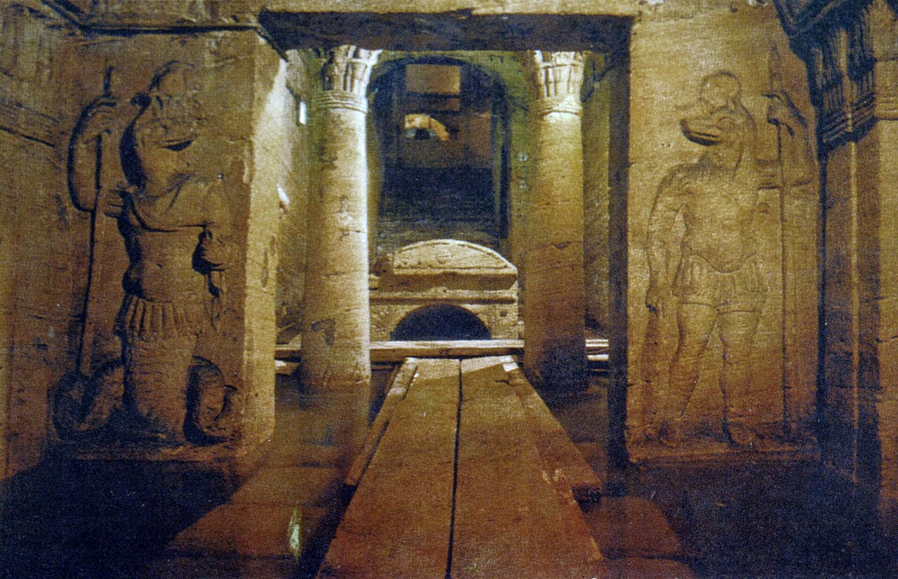
This paper critically re-evaluates the Catacombs of Kom El-Shoqafa in Alexandria, challenging the consensus attributing the monument to a wealthy local family. Instead, it proposes the complex was originally conceived as a Flavian imperial memorial tomb commemorating Emperor Vespasian. Utilizing an interdisciplinary methodology, the study synthesizes archaeological, legal, art-historical, and numismatic evidence to resolve structural and iconographical anomalies. It examines how the monument’s urban location violated Roman burial laws within the framework of strict constitutional controls over Aegyptus. Furthermore, the hybrid decorative program, integrating Pharaonic regalia, the Praetorian Guard, and Greek architecture, is correlated with Flavian political iconography, reflecting Alexandria’s pivotal role in proclaiming Vespasian emperor in 69 AD. To resolve chronological contradictions, Antonine-period features are reinterpreted as modifications necessitated by Domitian’s damnatio memoriae. Ultimately, this study redefines Kom El-Shoqafa as an imperial-religious sanctuary engineered for dynastic propaganda, transforming our perspective on Roman Alexandria.
Downloads
References
1. Birley, A. R. (1988). Septimius Severus: The African emperor (2nd ed.). Routledge.
2. Bishop, M. C. (2022). Roman plate armour (G. Rava, Illus.; Elite 247). Osprey Publishing.
3. Borowik, M. (2020). Funerary practices in ancient Alexandria in the Graeco-Roman period (332 BC–AD 642): Examples for syncretism in Alexandrian tombs and necropolises (Bachelor’s thesis). University of Warsaw.
4. Bresciani, E. (1989). L'attività politica e militare di C. Cornelio Gallo in Egitto. Egitto e Vicino Oriente, 12, 93–98.
5. Davies, P. J. E. (2000). Death and the emperor: Roman imperial funerary monuments from Augustus to Marcus Aurelius. Cambridge University Press.
6. Delbrueck, R. (1912). Hellenistische Bauten in Latium (Vol. 2). Karl J. Trübner.
7. Erman, A. (1896). Die Stele des Cornelius Gallus. Sitzungsberichte der Königlich Preussischen Akademie der Wissenschaften zu Berlin, 1, 469–474.
8. Eutropius. (1993). The breviarium ab urbe condita of Eutropius (H. W. Bird, Trans.). Liverpool University Press. (Original work published ca. 369 AD).
9. Herklotz, F. (2011). Aegypto capta: Augustus and the annexation of Egypt. In L. Capponi (Ed.), Roman Egypt (pp. 13–24). Bristol Classical Press.
10. Johnson, M. J. (1996). The Mausoleum of Augustus: Etruscan and other influences on its design. In J. F. Hall (Ed.), Etruscan Italy: Etruscan influences on the civilizations of Italy from antiquity to the modern era (pp. 211–239). Brigham Young University Museum of Art.
11. Kaper, O., (2012). “The Western Oases”, in The Oxford handbook of Roman Egypt (1st ed.). Oxford University Press.
12. Kelly, B. (2010). Tacitus, Germanicus and the kings of Egypt (Tac. Ann. 2.59-61). The Classical Quarterly, 60(1), 221–237.
13. Lassard, Y. (2013). The Twelve Tables (about 451–449 BC). The Roman Law Library.
14. Levick, B. (1999). Vespasian. Routledge.
15. Masoud, A. H. (2020). The main tomb at catacombs of Kom El-Shoqafa: A new reading. Bulletin of the Center of Papyrological Studies (BCPS), 37(2), 215–245.
16. Mattingly, H., & Sydenham, E. A. (1926). The Roman imperial coinage: Vol. I. From 31 BC to AD 69. Spink & Son.
17. Minas-Nerpel, M., & Pfeiffer, S. (2010). Establishing Roman rule in Egypt: The trilingual stela of C. Cornelius Gallus from Philae. In A. J. Turner (Ed.), The first year of Roman rule in Egypt (Proceedings of the British Academy 161). Oxford University Press.
18. Omran, W., & Zouair, N. (2014). The depiction of Apis in the Greco-Roman tombs of Egypt. Journal of Association of Arab Universities for Tourism and Hospitality, 11(1), 43–58.
19. Plutarch. (1914). Lives: Volume I. Theseus and Romulus. Lycurgus and Numa. Solon and Publicola (B. Perrin, Trans.; Loeb Classical Library 46). Harvard University Press.
20. Riggs, C. (Ed.). (2012). “Introduction”, in The Oxford handbook of Roman Egypt (1st ed.). Oxford University Press.
21. Rollinger, C. (2025). The Puteoli block in the Penn Museum’s Rome gallery. Expedition Magazine, 67(2).
22. Rose, C. B. (2025). Carving out Domitian: The Puteoli marble block. Expedition Magazine, 67(2), 17–31.
23. Rowe, A. (1942). Kom el-Shukafa in the light of the excavations of the Graeco–Roman Museum during the season (1941-1942). Bulletin de la Société Archéologique d'Alexandrie (BSAA), 35, 3–45.
24. Savvopoulos, K., & Bianchi, R. S. (2012). Alexandrian sculpture in the Graeco-Roman Museum (Graeco-Roman Museum Series 1). Alexandria and Mediterranean Research Center.
25. Schreiber, T. (1908). Expedition Ernst von Sieglin: Ausgrabungen in Alexandria. Die Nekropole von Kôm-esch-Schukâfa (Band I: Text; Teil II: Tafeln). Giesecke & Devrient.
26. Servius, M. H. (1881). In Vergilii carmina comentarii. In G. Thilo & H. Hagen (Eds.), Servii Grammatici qui feruntur in Vergilii carmina commentarii. B. G. Teubner.
27. Smith, W. (Ed.). (1875). A dictionary of Greek and Roman antiquities. John Murray.
28. Sullivan, T. (2024). Rome’s greatest emperor: Vespasian (1st ed.). Pen & Sword History.
29. Venit, M. S. (2002). Monumental tombs of ancient Alexandria: The theater of the dead. Cambridge University Press.
30. Venit, M. S. (2016). Visualizing the afterlife in the tombs of Graeco-Roman Egypt. Cambridge University Press.
31. Wandrey, K. A. (2013). Gaius Avidius Cassius. In R. S. Bagnall et al. (Eds.), The encyclopedia of ancient history (1st ed., pp. 997–998). Blackwell Publishing Ltd.
32. Wilcken, U. (1897). Zur Trilingue von Philae. Zeitschrift für Ägyptische Sprache und Altertumskunde, 35, pp. 70-80.
Downloads
Published
Issue
Section
Categories
License
Copyright (c) 2026 Magdi Mahmoud Abdelhamid Ibrahim (Author)

This work is licensed under a Creative Commons Attribution 4.0 International License.


