The Medicinal Plants in Ahmed Pasha Kamal’s Dictionary of Plants and Trees: Al-La’ali’ Al-Durriya fi Al-Nabatat wa Al-Ashjar Al-Qadima Al-Misriyya A Glimpse into Ancient Egyptian Remedies
Keywords:
Ahmed Pasha Kamal; Dictionary of Plants and Trees; medicinal plants; herbal remedies science heritage.Abstract
https://doi.org/10.5281/zenodo.18436206
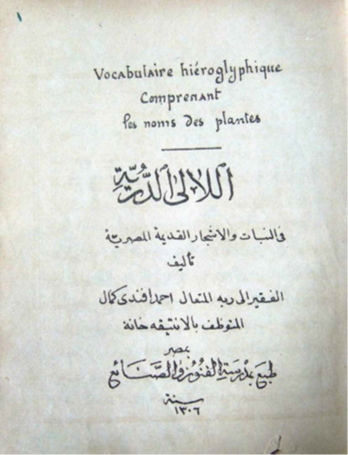
Ahmed Pasha Kamal was the first Egyptian scholar to write his own ancient Egyptian dictionary, Le lexique de la langue Egyptienne ancienne totaling 22 volumes, including more than 13,000 hieroglyphic entries translated to French and Arabic, yet following different methodology. Kamal’s knowledge production was varied in languages and in targeting audience. He published in Arabic for the Egyptian people and in French (mainly) and English for westerns. Among his publications is “The Dictionary of the Ancient Plants and Trees” اللآلئ الدرية في النباتات والأشجار القديمة المصرية Al-La’ali’ Al-Durriya fi Al-Nabatat wa Al-Ashjar Al-Qadima Al-Misriyya, which is an encyclopedic work that is considered one of the most important references in the study of ancient Egyptian flora. Published in the late 19th century, this dictionary provides comprehensive information about plants used in ancient Egypt, including their names in hieroglyphics, along with translations into Arabic and French. The dictionary is organized alphabetically, it includes detailed descriptions of specific plants and trees, noting their physical characteristics and traditional uses. Moreover, it outlines how these plants were used in religious rituals, medicinal treatments, and daily life, such as growing grains, preparing oils, and crafting wood. In this research paper, we will present an overview of the medicinal remedies discussed by Kamal in his study of the uses of plants in the Dictionary of Plants and Trees, to be compared with the terms found in his 22 volumes dictionary.
Downloads
References
1. Abd al-Nūr, Muʿawwaḍ Dāwūd. (2000). Qāmūs al-Lahjatayn al-Ṣaʿīdiyya wa-al-Baḥriyya. Cairo.
2. Abouelata, M. (2018). Travel to the healing centers in the egyptian temples: the prototype of the modern medical tourism. Egyptian Journal of Archaeological and Restoration Studies 8(2), 121-132.
3. Al-Rāzī (2000). Al-Ḥāwī fī al-Ṭibb, vol. 7, reviewed and corrected by Muḥammad Muḥammad Ismāʿīl. Beirut.
4. Al-Sharqāwī, B. S. (2010). Aḥmad Bāshā Kamāl: Rāʾid al-Tanwīr al-Atharī al-Waṭanī. Majallat al-Muqtaṭaf al-Miṣrī al-Tārīkhiyya - al-Iṣdār al-Awwal, year 2, issue 4, 1-36. Retrieved from http://search.mandumah.com/Record/708147
5. ______________. (2011). Ṣuʿūd al-Sullam, Aḥmad Bāshā Kamāl (1851-1923 CE) wa-Muʿjamuhu li-al-Lugha al-Miṣriyya al-Qadīma (Dirāsa Taʾrīkhiyya-Iḥṣāʾiyya). Abjadiyyāt 6, 44-70.
6. Ibn al-Bayṭār (1992). Al-Jāmiʿ li-Mufradāt al-Adwiya wa-al-Aghdhiya, vol. 2. Beirut.
7. El-Qobiesy, B. (2011). Ahmed Kamal Pasha: the philologist of Egyptian hieroglyphs. Abgadiyat 6, 33–43.
8. Brugsch, H. (1868a). Hieroglyphisch-Demotisches wörterbuch II. Leipzig.
9. _________. (1868b). Hieroglyphisch-Demotisches wörterbuch IV. Leipzig.
10. Benner, J.A. (2009). Ancient Hebrew dictionary. USA.
11. Černý, J. (1976). Coptic etymological dictionary. Cambridge.
12. Chabas, F. (1864). Lettre à F. Chabas sur un fragment Hiératique se rattachant au papyrus de Berlin no. II’. In F. Chabas, (ed.) Mélanges Égyptologiques, deuxième série. Chalon-sur-Saône. 249-272.
13. Chabas, F. (1861). Le cèdre dans les Hiéroglyphes’, Revue Archéologique, nouvelle série 4, 47-51.
14. Chabas, F. (1866). Voyage d’un Égyptien en Syrie, en Phénicie, en Palestine, etc. Paris.
15. Crum, W.E. (1939). A Coptic dictionary. Oxford.
16. Davies, N. (1943). The tomb of Rekhmire at Thebes. New York.
17. Deines, H. & Grapow, H. (1959). Wörterbuch der Ägyptischen Drogennamen. Berlin.
18. Duemichen, J. (1866). Altägyptische kalenderinschriften In den Jahren 1863 1865 an Ort und stelle gesammelt. Leipzig.
19. Erichsen, W. (1933). Papyrus Harris I: Hieroglyphische transcription. Bruxelles.
20. Erman, A. & Grapow, H. (1926). Wörterbuch der Aegyptischen sprache I. Berlin.
21. _________________, H. (1928). Wörterbuch der Aegyptischen sprache II. Berlin.
22. _________________, H. (1929). Wörterbuch der Aegyptischen sprache III. Berlin.
23. _________________, H. (1930). Wörterbuch der Aegyptischen sprache IV. Berlin.
24. _________________, H. (1931). Wörterbuch der Aegyptischen sprache V. Berlin.
25. Ezz el-Din, D. & Elkasrawy, S.F. (2020). Pomegranates of ancient Egypt: representations, uses and religious significance. In C. Graves (ed.) Proceedings of the Fourth British Egyptology Congress 4. London. 55-69.
26. Ezzat, A. & Mansour, A. (2024). Towards building a database of Ahmed Pasha Kamal’s Hieroglyphic dictionary: obstacles and challenges. In L. Dogaer et al. (eds.) Proceedings of the Twenty-Third Annual Symposium, University of Basel, 10-14 September 2023. Oxford. 116-128.
27. Faulkner, R.O. (1988). A concise dictionary of middle Egyptian. Oxford.
28. Gardiner, A.H. (1937). Late Egyptian Miscellanies. Bruxelles.
29. Germer, R. (1985), Flora des pharaonischen Ägypten. Mainz.
30. ________. (2008), Handbuch der altägyptischen heilpflanzen. Wiesbaden.
31. Ghareeb, W.H. (2021). Medicine in Ancient Egypt. Retrieved from https://www.researchgate.net/publication/374553760_Medicine_in_ancient_Egypt
32. Groser, W.H. (1888). Scriptural natural history: 1. the trees and plants mentioned in the Bible. London.
33. Helck, W. (1963). Materialien zur Wirtschaftsgeschichte des Neuen Reiches IV. Wiesbaden.
34. Hugonot, J.C. (1989), Le jardin dans l’Egypte ancienne. Frankfurt.
35. Kamāl, Aḥmad Afandī. (1894). Al-Laʾāliʾ al-Durriyya fī al-Nabāt wa-al-Ashjār al-Qadīma al-Miṣriyya. Cairo.
36. Kamāl, Aḥmad Bek. (1909). Bughyat al-Ṭālibīn fī ʿUlūm wa-ʿAwāʾid wa-Ṣanāʾiʿ wa-Aḥwāl Qudamāʾ al-Miṣriyyīn. Cairo.
37. Kamal, A. (2002a), Makhṭuṭ Muʻjam al-Lugha al-Misriya al-Qadimah: Manuscript Lexique de la Langue Egypienne Ancienne 1, Cairo.
38. ________. (2002b), Makhṭuṭ Muʻjam al-Lugha al-Misriya al-Qadimah: Manuscript Lexique de la Langue Egypienne Ancienne 2, Cairo.
39. ________. (2002c), Makhṭuṭ Muʻjam al-Lugha al-Misriya al-Qadimah: Manuscript Lexique de la Langue Egypienne Ancienne 3, Cairo.
40. ________. (2002d), Makhṭuṭ Muʻjam al-Lugha al-Misriya al-Qadimah: Manuscript Lexique de la Langue Egypienne Ancienne 5, Cairo.
41. ________. (2002e), Makhṭuṭ Muʻjam al-Lugha al-Misriya al-Qadimah: Manuscript Lexique de la Langue Egypienne Ancienne 12, Cairo.
42. ________. (2002f), Makhṭuṭ Muʻjam al-Lugha al-Misriya al-Qadimah: Manuscript Lexique de la Langue Egypienne Ancienne 15, Cairo.
43. ________. (2002g), Makhṭuṭ Muʻjam al-Lugha al-Misriya al-Qadimah: Manuscript Lexique de la Langue Egypienne Ancienne 20, Cairo.
44. Keimer, L. (1984). Die gartenpflanzen im alten Ägypten 2 vols. Hamburg–Berlin–Mainz.
45. Koura, B. (1995). Ist bAq moringaöl oder olivenöl. Göttinger Miszellen 145, 79-82.
46. Lepsius, G. (1842). Das Todtenbuch der Ägypter nach dem Hieroglyphischen Papyrus in Turin. Leipzig.
47. Levi, S. (1889). Vocabolario Geroglifico Copto-Ebraico, vol. VII supplement. Torino.
48. Loret, V. (1880). Étude sur quelques arbres Égyptiens II, Recueil de traveaux relatifs à la philologie et à l'archéologie égyptiennes et assyriennes (RecTrav) 2, 60-65.
49. ______. (1886). Recherches sur Plusieurs Plantes Connues des Anciens Égyptiens, RecTrav 7, 101-114.
50. ______. (1882). Les fêtes d’Osiris au Mois de Khoiak [1]. RecTrav 3, 43-57.
51. ______. (1883). Les fêtes d’Osiris au Mois de Khoiak [2]. RecTrav 4, 21-33.
52. ______. (1884). Les fêtes d’Osiris au Mois de Khoiak [3]. RecTrav 5, 85-103.
53. ______. (1892). La flore pharaonique d’apres les documents Hieroglyphiques et les specimens decouverts dans les tombes. Paris.
54. Manniche, L. (1989). An Ancient Egyptian Herbal. Austin.
55. Montanari, F. (2015). The Brill Dictionary of Ancient Greek. Leiden-Boston.
56. Naville, É. (1917). Some geographical names. The journal of Egyptian archaeology 4, 228-233.
57. Nunn, J.F. (2002), Ancient Egyptian Medicine. University of Oklahoma press.
58. Wilkinson, A. (1998). The Garden in Ancient Egypt. London.
59. Rashwan, H. (2023). Intellectual decolonization and harmful nativism: Arabic knowledge production of ancient Egyptian literature, interventions. International journal of postcolonial studies 26 Issue 5, 661-698.
60. Sharpe, S, (1870), The decree of Canopus in Hieroglyphics and Greek. London.
61. Spiegelberg, W. (1921), Koptisches Handwörterbuch. Heidelberg.
62. Woenig, F. (1886). Die pflanzen im alten Aegypten. Leipzig.
63. Wreszinski, W. (1909). Die Medizin der Alter Ägypter I: der grosse medizinische papyrus des Berliner Museums (Pap. Berl. 3038). Leipzig.
64. Wreszinski, W. (1913), Die Medizin der Alter Ägypter III: der papyrus Ebers. Leipzig.
65. Zoega, G. (1810). Catalogus codicum Copticorum manu scriptorum qui in museo borgiano velitris adservantur. Romae.
- https://aaew.bbaw.de/tla/ (TLA)
- https://dictionary.abyssinica.com/pomegranate
- https://sae.saw-leipzig.de/en/documents/papyrus-ebers (SAW)